
Tolland County Arrest Records and Court Charges
Arrest records start with the agency that made or documented the arrest, such as a town police department, resident state trooper, UConn Police for campus matters, or Connecticut State Police Troop C. Once the case moves into court, the formal charge lines appear in Connecticut Judicial Branch criminal and motor-vehicle systems. Connecticut has no county sheriff jail system for Tolland County, so arrest, custody, and court-charge records are not held in one county office.
Court charges after arrest are different from the full criminal case file. A charge line may show the alleged offense, statute reference, court location, docket number, and status. The complete case record can also include pleas, motions, dispositions, sentencing, probation, and later changes. Use Tolland County criminal court records for the full case file and Tolland County inmate records for DOC custody status.
How to Find Tolland County Arrest Records and Charges
Start with the Judicial Branch criminal/motor-vehicle docket tools for the court charge record. Search pending cases, conviction records, daily dockets, or docket-number routes. For Tolland County, the practical court filters are Rockville GA 19 and Tolland Judicial District. Police reports and arrest reports may require the arresting agency; DOC custody information requires the statewide DOC inmate search.
- Search the Judicial Branch criminal/motor-vehicle docket tools from the case lookup menu.
- Use defendant name or docket number, then narrow by Rockville GA 19 or Tolland Judicial District when possible.
- Open the public docket result and read each charge line, court location, event date, and disposition field.
- Check DOC inmate search if the person may be in custody, and use the arresting police agency for arrest reports.
- Contact the clerk for certified court copies or older documents not visible online.
The DOC and victim-notification sources below are useful for custody context after arrest, but they do not replace the court docket. A person can be arrested without a final conviction, and a person can have a conviction record without current DOC custody.
How Charges Get Filed After an Arrest
In Connecticut, the charge pathway is better described as arrest or summons, prosecutor review, court filing, and docket tracking. Research did not support publishing county-specific grand jury or indictment instructions for ordinary Tolland charges. The key local split is between GA 19 handling many criminal, misdemeanor, motor-vehicle, and infraction matters and the Tolland Judicial District handling more serious judicial-district prosecutions.
| Step | Record Created | Where to Verify |
|---|---|---|
| Arrest or summons | Police or agency arrest/report record. | Arresting agency, town police, Troop C, or UConn Police where applicable. |
| Prosecutor review | Formal charge decisions and possible amendments. | State's Attorney and public court docket. |
| Court docket | Charge line, docket number, events, and status. | Judicial Branch CRDockets and clerk of the court of record. |
| Custody after court | DOC inmate profile if held in state custody. | Connecticut DOC inmate information search. |
Charge Status and What It Means
Charge status can change as a case moves. A pending charge may be amended, reduced, dismissed, nolled, resolved by plea, or result in a conviction. The Judicial Branch convictions search displayed a daily accuracy timestamp during research and warns that criminal-history record information may change because of erasures, corrections, pardons, and other modifications.
| Status | What It Means |
|---|---|
| Pending | The charge remains unresolved on the court docket. |
| Amended / Reduced | The charge changed after filing, often through prosecutor action or court proceedings. |
| Dismissed | The charge ended without a conviction through court or prosecutor action. |
| Nolle | The prosecutor decided not to proceed with the charge at that time. |
| Conviction | The charge resulted in a guilty plea or finding, subject to later correction, pardon, or erasure rules. |
Charges vs. Convictions
Being charged is not the same as being convicted. Tolland County arrest records and court charges may show accusations that later end in dismissal, nolle, acquittal, reduction, or erasure. A background check, court docket, and police report may therefore show different parts of the same event.
| Charge | Conviction | |
|---|---|---|
| Stage | Formal accusation after arrest, summons, or prosecutor action. | Final guilty finding or plea on a charge. |
| Best Search | Pending case, daily docket, and docket-number searches. | Judicial Branch conviction search and certified clerk copies. |
| Risk | May not reflect final outcome. | May still be affected by erasure, correction, or pardon. |
Sealed vs. Erased Records
Connecticut research supports the term erased for qualifying criminal records. Sealed records are hidden by law or court order. Erased records under CGS 54-142a are removed from ordinary public disclosure after qualifying outcomes. Juvenile and youthful offender records have separate confidentiality rules and should not be treated as routine arrest-record results.
| Sealed | Erased | |
|---|---|---|
| Visibility | Not visible to the public without authorization. | Removed from public disclosure under Connecticut law. |
| How to Check | Contact the clerk or seek court authorization if eligible. | Verify disposition and erasure status with the court process. |
| Common Limits | Protected, juvenile, and safety-sensitive information. | Dismissed, nolled, pardoned, or otherwise qualifying criminal records. |
Prosecutor Review and State's Attorney Role
Connecticut prosecutors are State's Attorneys, not district attorneys. The Tolland State's Attorney prosecutes criminal offenses in the Tolland Judicial District, including communities such as Vernon, Mansfield, Tolland, Stafford, Somers, Coventry, Ellington, Hebron, and Willington. More serious Part A matters are handled through Rockville Superior Court, while GA 19 handles many lower-level criminal and motor-vehicle matters.
The U.S. Attorney's Office for the District of Connecticut appears in the manifest as a federal prosecution source and is separate from local Superior Court charges.
Federal charges do not belong to the Tolland Superior Court docket, so this source helps mark the boundary between state and federal prosecution.
Custody Records After Arrest
Connecticut does not have a Tolland County jail roster. If a person is held after a Tolland County arrest, public custody information is searched through Connecticut DOC. Males held pretrial for Rockville Superior Court matters often route to Hartford Correctional Center, females route to York CI, and sentenced or transferred people may appear at any DOC facility. DOC custody data is not the same as a court charge record.
The DOC statewide visiting rules source is relevant for people following custody status after arrest.
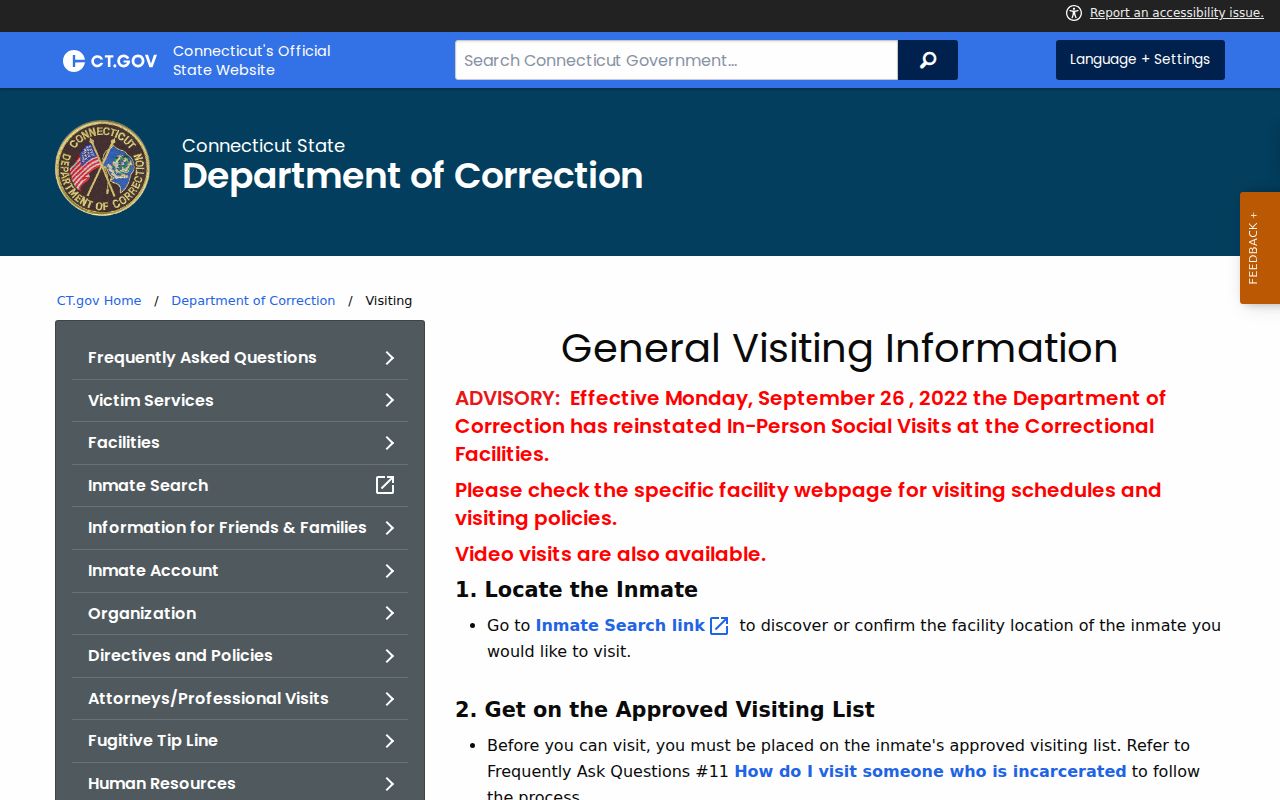
Visiting rules belong to DOC custody administration, not the Superior Court clerk.
The DOC inmate accounts page explains the trust-fund channel for funds after a person enters DOC custody.
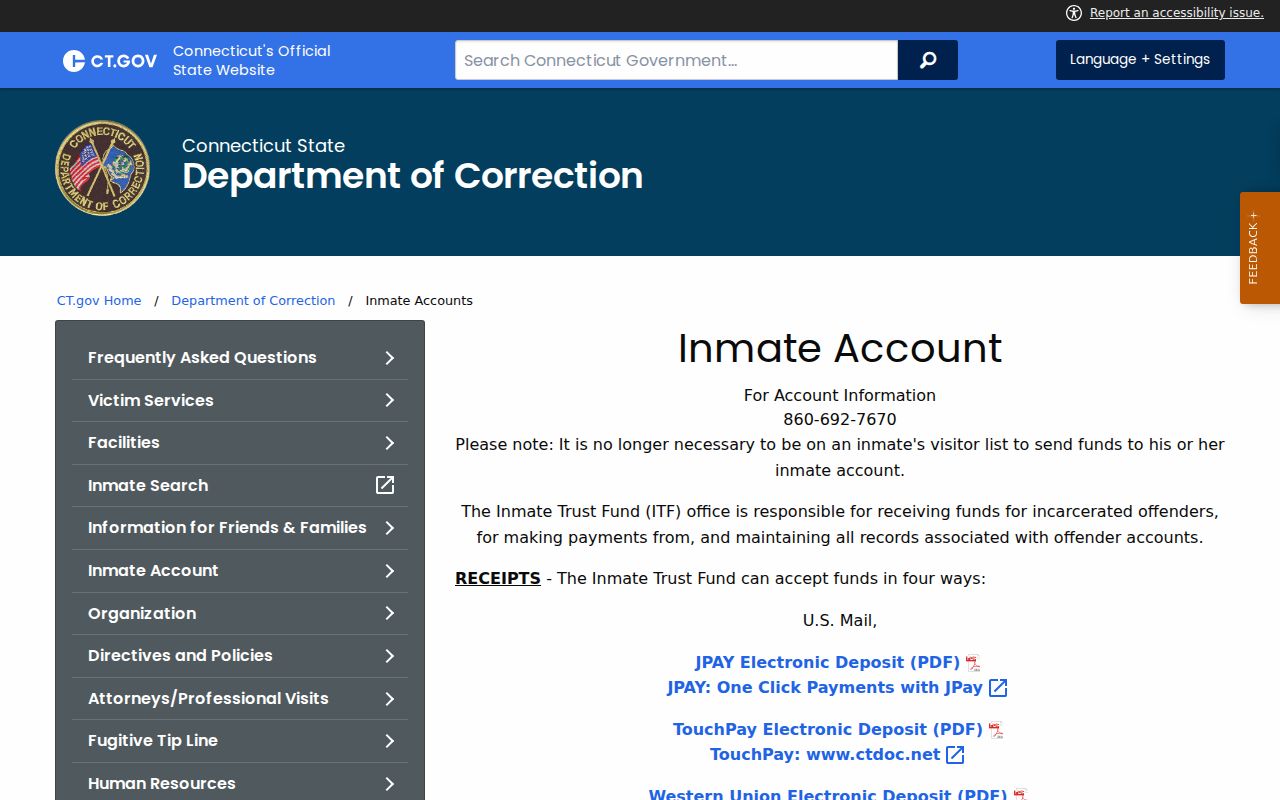
That source supports the distinction between custody logistics and the court docket for charges.
Statewide Charge and Criminal History Lookups
DESPP criminal-history records, Judicial Branch court charges, DOC custody profiles, and police arrest reports serve different purposes. A person seeking a formal criminal-history response should use the State Police Bureau of Identification or DESPP criminal-history process, not simply print a docket. A person tracking an open charge should use CRDockets and the appropriate clerk.
The Federal Bureau of Prisons inmate locator appears in the manifest as a federal custody source, which applies only when custody is federal.
Federal custody is outside the Connecticut DOC and Tolland Superior Court charge workflow.
Connecticut VINELink is a victim-notification and custody-status entry point, not a court charge database.

VINELink can assist with custody notifications while the court docket remains the source for charge status and disposition.
Background Check Considerations
Arrest and charge records can be incomplete or misleading if used without final disposition. A charge may be dismissed, nolled, corrected, pardoned, erased, or sealed. Official screening may require a certified court copy, DESPP criminal-history response, consent, and purpose-specific compliance beyond a public web lookup.
Important: This website is not a consumer reporting agency and cannot be used for FCRA-regulated screening decisions.
Restricted Charge Records in Tolland County
Restricted charge records include juvenile matters, youthful offender records, sealed charges, erased criminal records, protected addresses, safety-sensitive warrant information, and investigative material not yet filed or released. If an arrest report, custody profile, and court docket do not match, verify with the agency that created the specific record rather than assuming all records update at the same time.